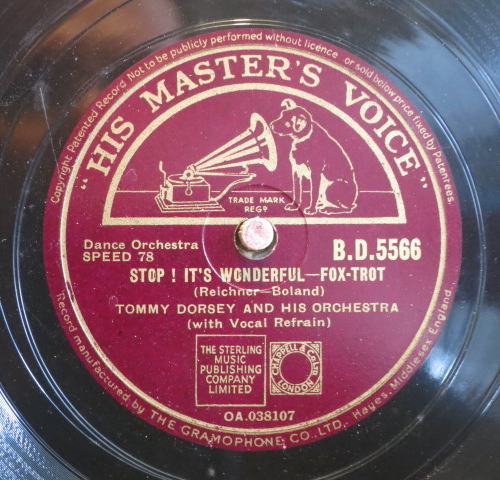
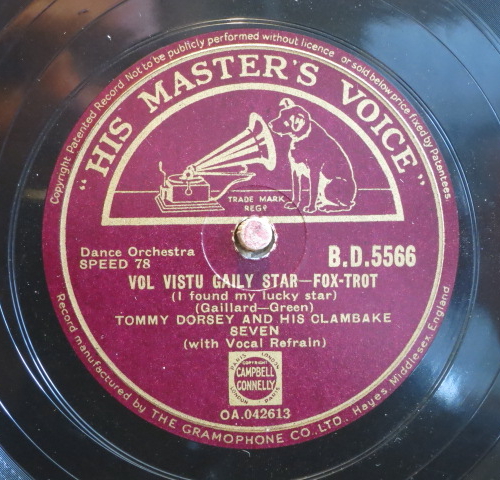
Der Schellackplatten-King aus Bochum präsentiert diese originale 78 RPM Schellackplatte von Tommy Dorsey And His Orchestra mit den Titeln „Stop! It’s Wonderful“ und „Vol Vistu Gaily Star“, zwei herausragende Aufnahmen aus der späten Swing-Ära. Beide Stücke, die ursprünglich 1939 in den USA auf RCA Victor aufgenommen wurden, sind stilistisch dem Übergang der späten 1930er Jahre zu den frühen 1940er Jahren zuzuordnen und spiegeln die musikalische Entwicklung der Big-Band-Ära wider. „Stop! It’s Wonderful“ besticht durch seine lebendige Melodie und energiegeladene Orchestrierung, die typisch für die späten Swing-Jahre ist, während „Vol Vistu Gaily Star“ mit einer eleganten, fast lyrischen Gestaltung die dynamischen Klangfarben dieser Zeit einfängt. Die britische Veröffentlichung auf His Master’s Voice unter der Katalognummer B.D.5566 wurde gegen Ende der 1930er Jahre gepresst, wahrscheinlich um 1939 oder Anfang 1940, und ist somit ein repräsentatives Beispiel für die Übergangsphase der späten Swing-Ära. Innerhalb der HMV-Systematik lässt sich die Entwicklung der Serien in ihrer zeitlichen Abfolge klar nachvollziehen: Die „B“-Serie steht für die frühe Standard-Swing-Hauptserie (ca. 1936–1941), die „B.D.“-Serie für die Kriegs- und Übergangsphase (ca. 1944–1947) und die „X“-Serien für spätere Reissue-, Export- und Nachkriegsausgaben der 1940er bis 1950er Jahre. Die „B.D.“-Nummerierung markiert somit eine typische Übergangsphase innerhalb der HMV-Katalogstruktur zwischen der Vorkriegsproduktion und der Nachkriegssystematik.
The Shellac Record King from Bochum presents this original 78 RPM shellac record by Tommy Dorsey And His Orchestra with the titles "Stop! It’s Wonderful" and "Vol Vistu Gaily Star," two outstanding tracks from the late Swing era. Both pieces, originally recorded in 1939 in the USA for RCA Victor, are stylistically linked to the transition between the late 1930s and early 1940s, reflecting the musical evolution of the Big Band era. "Stop! It’s Wonderful" stands out with its lively melody and energetic orchestration, typical of the late Swing years, while "Vol Vistu Gaily Star" captures the dynamic tonal colors of the time with its elegant, almost lyrical arrangement. The British release on His Master’s Voice under catalog number B.D.5566 was likely pressed at the end of the 1930s, around 1939 or early 1940, making it a representative example of the transitional phase of the late Swing era. Within the HMV catalog system, the development of the series can be clearly traced: The "B" series represents the early standard Swing main series (ca. 1936–1941), the "B.D." series covers the war and transitional period (ca. 1944–1947), and the "X" series includes later reissue, export, and postwar releases from the 1940s to the 1950s. The "B.D." numbering thus marks a typical transitional phase within the HMV catalog structure, bridging pre-war production and post-war categorization.